
What is an ERP system, what a great helper is it in many areas and how can it simplify several tasks, including eliminating the occurrence of unnecessary errors? It is most commonly found in human resource management, finance, economics and logistics, but it is also used outside of these areas. What is an ERP system and what benefits can it give you?

Before we explain what an ERP system is, it’s important to find out what the acronym ERP actually stands for. The ERP acronym is made up of the first three letters of three English words – Enterprise Resource Planning, which translates to Enterprise Resource Planning.
In other words, ERP systems are used for comprehensive business management. People use them mainly to plan their goals and coordinate company resources or individual departments.
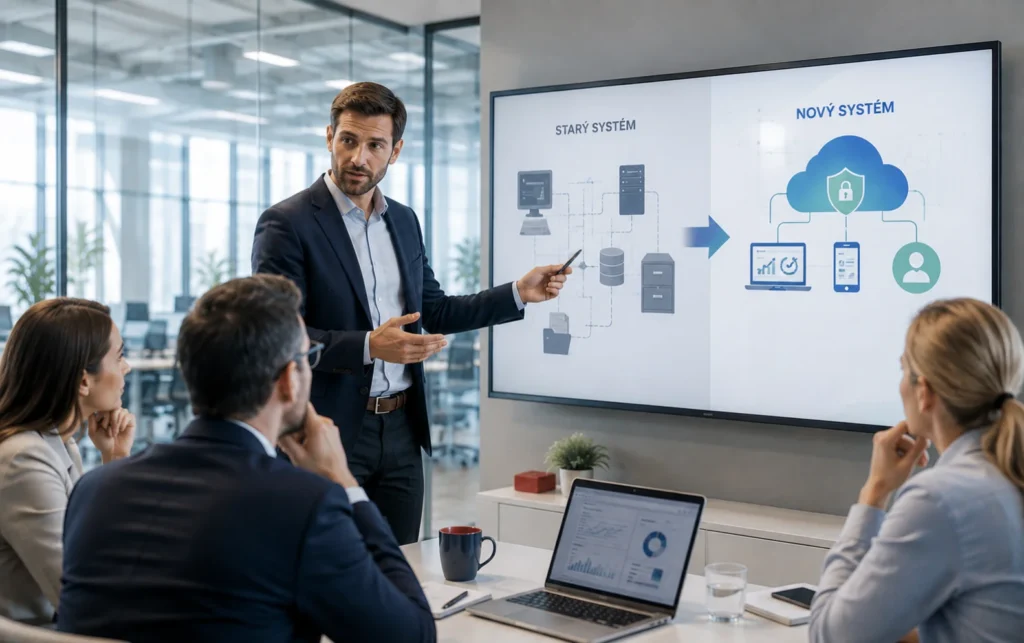
An ERP system can easily connect multiple business processes, providing better visibility and easy control over the entire company. So you can manage information about logistics, administration, warehouse, production, etc. in one system.
Interestingly, while today ERP systems are a practical tool without which companies cannot imagine their functioning, this was not the case in the past. The systems worked independently and separately. They were unable to communicate with other programs and systems. In addition, each program required a special and very expensive code. This negatively impacted the whole work process and often hindered the adoption of new technologies.
Modern ERP systems can be interfaced with other systems and working with them is relatively easy and fast. Employees don’t have to be IT specialists to know how to use them. All they need is a short training and a little practice. Another great advantage of ERPs is that most of them have enhanced security that ensures a high level of privacy protection.
ERP software is crucial in businesses for several reasons. The first reason is the fact that, thanks to automation and integration, it can efficiently manage day-to-day activities, saving time and making work easier.
ERP modules centralise and manage different business processes and data in one single unit. This sophisticated system allows you to effectively manage and monitor your resources. Ability to make individual decisions in a timely manner to achieve business objectives and minimize risks.
The importance of ERP varies depending on the industry. In logistics, for example, cooperation between customers and suppliers needs to be streamlined. Instead of handling the tasks for each of the parties in a separate software, you only need one, where you have the possibility to implement specific ERP modules.
The same is true within the financial area of the company. ERP systems give you an overview of paid and unpaid invoices from suppliers and customers. So you know which invoice your company hasn’t paid yet and which one someone has to pay to you.
Last but not least, an ERP system is also key in the strategic decision making of companies. It gives you real-time data so you know exactly where your business stands. Make sure you’re working with up-to-date information when you’re scheduling tasks or major changes. This allows you to achieve the most ideal results.
ERP systems have a wide range of applications. They are typically used in medium and larger enterprises, playing a key role in the various work processes in these areas:

An ERP system has a large number of advantages. Which benefits it will bring you depends mainly on what area you want to use it in. However, its biggest benefits generally include:
ERP systems also have a few disadvantages. The ones you should know about before you start using them include:
You can use other systems in your business besides ERP. Some may seem very similar at first, complicating the whole selection process. For a better overview, we have compared some of them.
CRM (Customer Relationship Management) is a system that manages all the ways a customer interacts with a company. Its main task is to collect and store customer information. CRM can work independently or as part of ERP.
The biggest difference between ERP and CRM is that ERP is a complex system providing dozens of features and countless uses. On the contrary, CRM is only used to manage customers and activities directed to them.
When thinking about whether to choose both solutions or just one of them, base your decision on the goals of the business. If the focus is more on streamlining management and establishing order, ERP is the obvious choice.
However, if your goals are more focused on building customer relationships, prospecting and maintaining them, a CRM is ideal. Alternatively, choose a combination of ERP and CRM, which, although more expensive, really does provide everything the business needs.
MRP (Material Requirements Planning) is a software designed to calculate the required materials and their quantities. In addition, it can also manage the timing of deliveries to meet the needs of customers. Like CRM, MRP can be a stand-alone unit or part of ERP.
When choosing one of the options, keep an eye on the needs of the business. MRP is ideal for companies looking to streamline production schedules and segment inventory. ERP is designed for those who want a comprehensive solution, including additional functions related to accounting, logistics, etc.
ECC (Enterprise Central Component), sometimes referred to as SAP ERP is often associated with the concept and comparison of ERP system vs SAP. However, SAP EPR is an IT enterprise resource planning system that includes various modules such as FI, HR, PM, PP. This is one of the ERP systems currently on the market. It is developed by SAP.
MES (Manufacturing Execution System) is used to monitor manufacturing processes. Its role is to help workers make important decisions within the production area. One of the characteristics of MES is that it operates in real time.
MES can be integrated into an ERP system, but it can also be standalone. The first option is more comprehensive and practical. It is ideal if the company also needs a system for other areas, such as logistics or finance.
EPM (Enterprise Performance Management) provides the detailed information needed for planning, analytics, data reporting or forecasting certain events. It provides users with advanced tools designed to make the information collected easier to understand.
EPM can be part of your ERP, giving you a comprehensive solution that guarantees the best working results.
ERP WMS (Warehouse Management System) is used to manage and control warehouse operations. This speeds up the receipt of goods from suppliers and the delivery of orders to customers.
The biggest difference between ERP and WMS is that WMS has a specific purpose, whereas ERP is a comprehensive package that you can use in different areas. It is a tailor-made solution that can also include a WMS. However, if you don’t need anything else besides WMS functionality, it’s not worth investing in an ERP system. It would be unnecessarily expensive and complicated for you.
The price of ERP systems in Slovakia or abroad depends on how many users will use them and what functions the company will need. In general, however, we can say that the cheapest solutions are in the range of 2- to 10-thousand Euros.
On the other hand, advanced and complex ERP systems in Slovakia with a wide range of functions and in the event that multiple ERP modules are implemented, the price can rise significantly. In the case of larger companies with complex processes and higher management requirements, the price of an ERP system can exceed 70 thousand Euros or more.
If you have experience with Java programming, relational databases or ERP systems and are looking for a job, respond to our Java developer offer and help us develop our ERP system that we use at msg life. We have great company benefits and in the Employer of the Year 2025 competition in the IT and Telecommunications category we ranked 4th place.
ERP systems are an important part of many businesses. Knowing them can open the door to new and interesting job opportunities. If you already have some experience and want to get into this field, take a look at our job offers. If you speak German, you can look directly at the job offer for Project Management Officer.
At msg life Slovakia I take care of the company culture, events and I am part of the marketing team. I like a job where I can be creative and contribute to making my colleagues at msg feel good. I regularly prepare for you
not only news and interesting things from the world of information technology and insurance, but also from behind the scenes events at msg life Slovakia.
See who translates insurance into code at msg life Slovakia.