

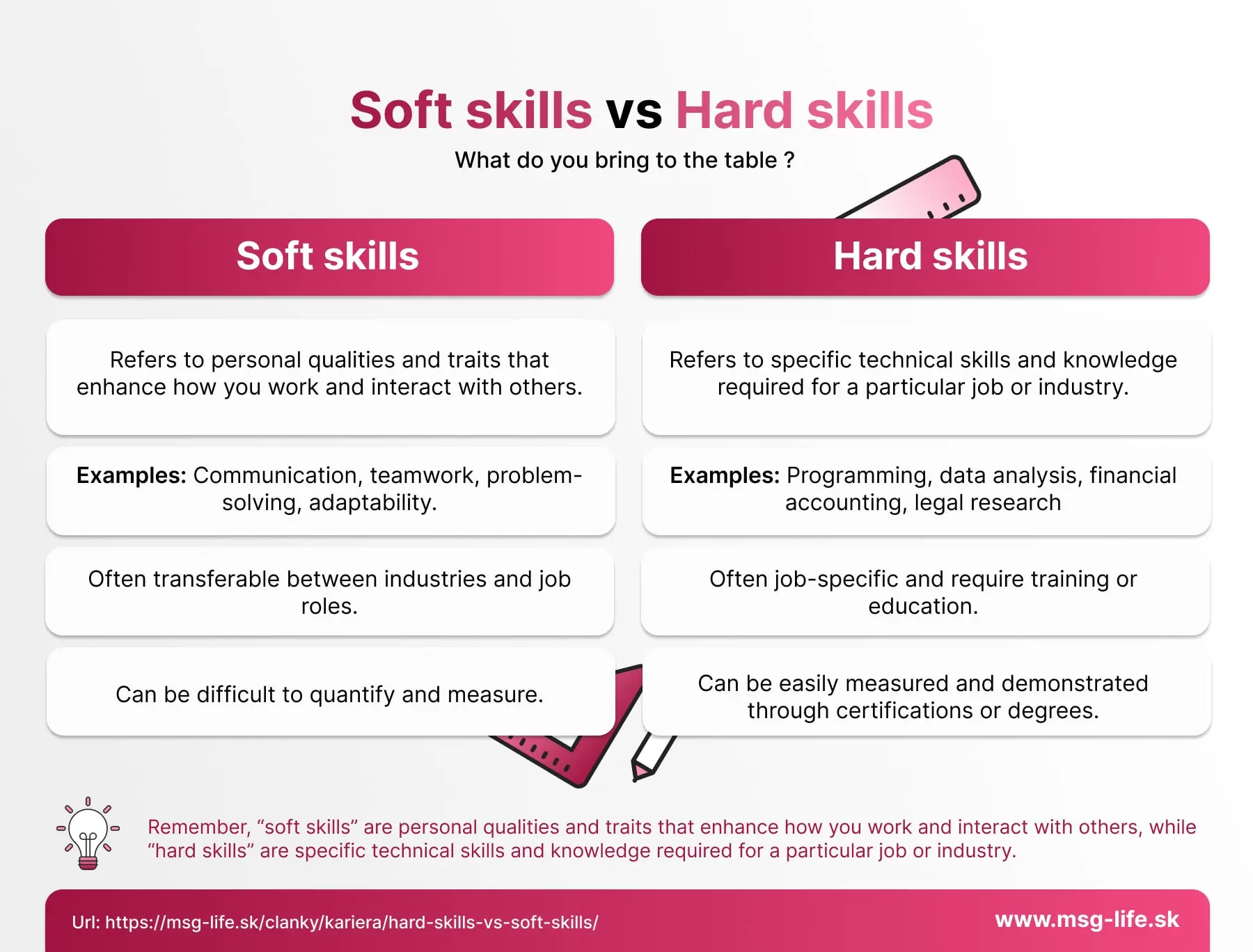
Hard skills vs soft skills – which are more important? If you’re asking yourself the same question, the answer is clear: both. Both hard and soft skills are an important set of qualities that can help you perform better at work, impress recruiters and land your dream job in fields like IT, marketing or even developing futuristic technologies for space missions. But before you set out to improve them, you should find out what these English terms actually mean and what the difference between them is.

The biggest difference lies in the way they are acquired and developed. You can learn hard skills directly at school, in workshops, training or courses. They are known for the fact that they can be measured in some way. A great example is language level, which is assessed from A1 to C2.
Soft skills are their opposite. Either a person is born with them and has them naturally, or he acquires them later through various life situations and experiences. This does not mean that they cannot be developed – quite the opposite. Soft skills are just as important to employers as hard skills, and in many cases they even favour them. So definitely don’t underestimate them.
The difference between hard skills and soft skills is also reflected in where you list them on your CV. Hard skills belong in the “Skills” section, which also includes information about the certificates, courses and workshops you’ve taken. You can also mention some in the ‘Education’ section, especially if you are describing your major or degree programme and the skills you have acquired.
Read more in the article: How to write a good CV and what mistakes to avoid?
And where to put soft skills? You can add them in the “Skills” section, which is usually under education on a CV, or mention them in a cover letter or cover letter. However, they are best presented directly at the interview and then at work.
As we have already indicated, soft skills represent skills that are more natural to humans. Many of these skills you have from birth, but you can develop them over the course of your life thanks to the different situations you find yourself in.
They are very difficult to measure. Their main role is to facilitate your functioning in society, improve interpersonal relationships and strengthen cooperation with others. They are important not only in work but also in personal life.
Although measuring and defining soft skills is challenging, it’s important to pay attention to them and continually develop them – especially during periods when you’re changing jobs or going through major life changes. For example, if you’ve worked remotely for years, your skills like teamwork or team leadership may not be at the same level as someone who has been in a team all the time.
Don’t underestimate the power of soft skills. They may seem less important than hard skills, but they play a key role in the work environment. They help you communicate effectively, understand colleagues, resolve conflict and think critically. This leads to better job performance, which can mean a promotion, a pay rise or a move to a better position.
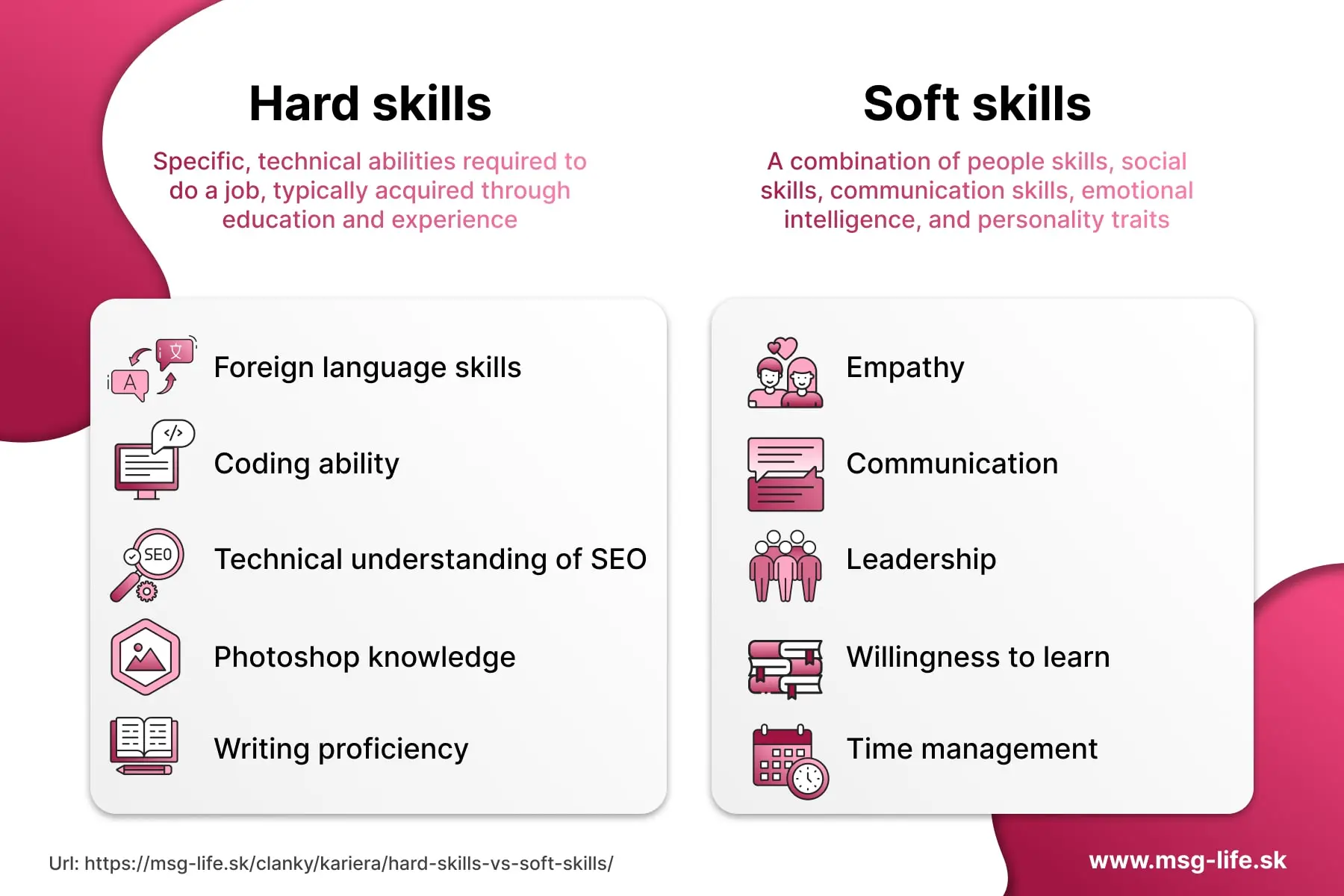
Imagine a situation where you have to solve a difficult task under time pressure. It is not enough to know how to program or analyse data, but also how to communicate effectively, manage stress and organise your time well. Soft skills include:
You don’t have to master them all to succeed. All you need is a combination of a few that you actively work on.
Interestingly, some soft skills can help you develop others. For example, if you focus on empathy, you’ll understand your colleagues better, which will help you improve communication.
Hard skills, also referred to as hard or technical skills, are skills you can learn throughout your life. You learn them either at school, on courses or on the job. They are known for being relatively easy to measure, most often through a variety of tests and tasks.
Since hard skills can be learned, you don’t have to have any special predisposition for them. However, it’s an advantage if you’re familiar with the field – learning new knowledge is much easier and more natural.
Another characteristic of hard skills is their specificity. Each profession requires a different set of skills that you should master (at least at a basic level) because they are needed to perform a specific job. This is a marked difference from soft skills, which are more universal and many of them, such as empathy or communication, can be used in any job field.
They are mostly related to technical knowledge, working with tools or professional practices in the field. Here are some of the most important hard skills that can increase your value on the job market:
Acquiring and developing hard skills and soft skills is not difficult if you know how to do it. The following tips can help.
You can gain and strengthen them in the following ways:
For acquiring and improving soft skills, you can do the following:
Hard skills and soft skills are equally important for career success. They influence each other greatly and enable you to achieve the best possible results at work. While hard skills make the technical side of the job easier, soft skills help you fit in with your team, work with others and communicate your ideas and goals effectively.
The best way to do this is to try to improve both types of skills – not only on a theoretical level, but also in practice.
Which skills you should put on your CV depends on the job and the requirements stated in the job advert. For some employers, empathy, communication, team leadership and foreign language skills are key. Others are looking for a candidate who is a natural leader, has an analytical mindset, can solve problems and is proficient with a variety of technical tools.
So make sure you read up carefully on the job offer and the employer and tailor your CV accordingly.
Also, remember that you should only highlight the main hard and soft skills that you know best on your CV. You can describe them briefly or say more about them in the interview. However, be sure to avoid a long list of qualities that tells the recruiter nothing about your real skills.


Hard skills are technical skills and knowledge that you can easily quantify and verify, such as programming, knowing foreign languages or working with specific software. Soft skills are interpersonal skills such as communication, teamwork and empathy that are harder to measure.
Hard skills are often the basis for success in specific professions. Employers use them to assess a candidate’s ability to perform the specific tasks and technical requirements for a position.
Soft skills are key to effective collaboration and communication in a team. They help create a positive working environment and are often a deciding factor in employee selection, as they influence how individuals engage in teamwork and interact with colleagues.
Examples of hard skills include programming (e.g. Python, Java), database skills (e.g. SQL), graphic design, proficiency in office applications (e.g. Microsoft Office) and technical writing.
Examples of soft skills include communication, teamwork, conflict resolution, empathy, time management and the ability to adapt to change.
You can take courses, trainings, certifications or self-study through online platforms to improve your hard skills. Hands-on experiences and projects are also an effective way to learn these skills.
You can improve your soft skills through active listening, engaging in team projects, attending workshops and personal development trainings, and practicing in real-life situations such as presentations or networking.
Yes, it is possible. Many professionals have excellent technical skills but may have problems with interpersonal communication or teamwork. The important thing is to find a balance between both types of skills.
When writing your CV, include specific examples of hard skills in the “Skills” section and put them in the context of your work experience. For soft skills, you can provide examples of situations where you have used these skills successfully, for example in projects or teamwork.
The combination of hard skills and soft skills is crucial for success in many professions. Hard skills provide technical competence, while soft skills enable effective interaction and collaboration with others, leading to better results and a more productive work environment.
Hard skills and soft skills are often underestimated and yet their balanced combination is an important essence for success at work. They will help you land your dream job, achieve your goals and keep moving forward. There are many ways to acquire and improve them. Find out which ones are most important to you and start working on them – you’ll not only improve your communication with colleagues, but also your ability to work in a team or solve more challenging problems.
At msg life Slovakia I take care of the company culture, events and I am part of the marketing team. I like a job where I can be creative and contribute to making my colleagues at msg feel good. I regularly prepare for you
not only news and interesting things from the world of information technology and insurance, but also from behind the scenes events at msg life Slovakia.
See who translates insurance into code at msg life Slovakia.