
Personality typology is a great tool to help you divide people into a few basic categories according to their traits and characteristics. This can be done based on a variety of theories, including Hippocratic, Goldberg, and Jungian. The advantage of personality typology is that it allows you to get to know your strengths and weaknesses and use them, for example, when looking for a new job.

Temperament is, from a psychological point of view, the totality of certain qualities by which a person is characterized. At the same time, it indicates how you view the world and what decisions you make.
Temperament has been of interest to many prominent personalities over the years. The first to address this topic was Hippocrates in the 4th to 5th centuries BC . His theory was later taken up by Galenos and then by Carl Gustav Jung, who brought his own view of temperament. Unlike Hippocrates, he divided people into two main groups – introverts and extroverts.
Regardless of the particular theory or personality, it is generally true that temperament is innate, manifested from childhood and does not change significantly throughout life. As a rule, only minor changes occur as a result of experience, new experiences, upbringing, education, and other external factors.
Personality tests are a practical tool to get to know your personality as well as your strengths and weaknesses. You can then work with these to achieve better work results and improve your personal relationships.
Tests are also great in that they give you objective feedback based on your answers. They can also help you identify weaknesses or negative traits that you may not be aware of, but may be holding you back in many ways.
However, to get a relevant result, you need to fill in the temperament test truthfully. Therefore, always think carefully when answering the questions.
Each of us develops and grows throughout our lives. We go through several stages that influence us greatly and change our view of the world in certain ways.
The stages vary depending on what source you are getting your information from. For example, Erik Erikson talks about 8 stages:
At each stage, different relationships influence a person. For example, in the first three it is relationships with parents and family, while in the sixth (intimacy vs. loneliness) it is friends and partners.
Sigmund Freud also spoke about the stages of personality development and divided them as follows:
If you were to look at the stages of personality development from a biopsychosocial model, you might also encounter such a division:
The importance of temperament was first explored by Hippocrates, who came up with the division into four personality types. He assigned to each the bodily juice that was supposed to have the greatest influence on it. However, to make using this theory easier, Galenos named all four personalities:
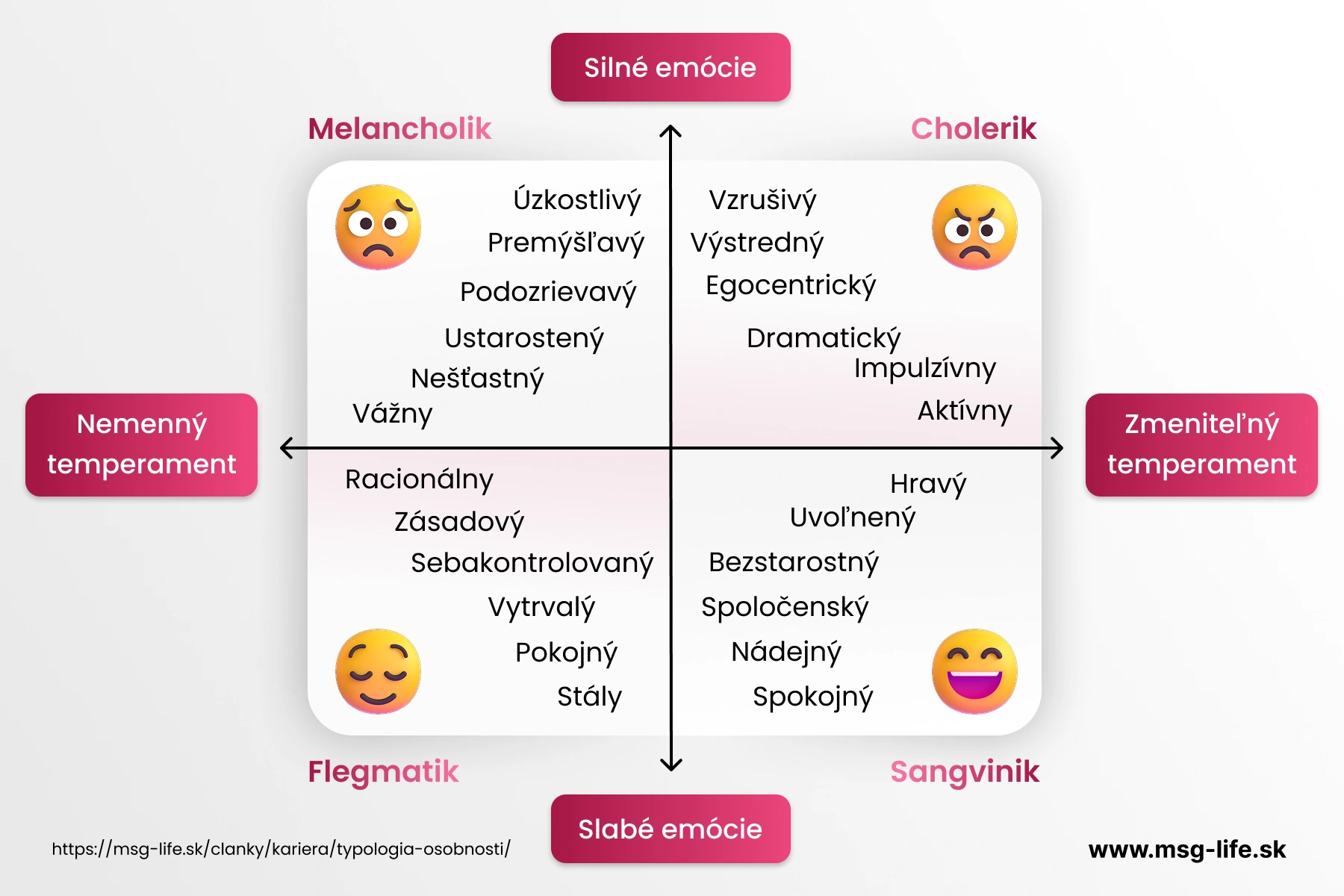
Hans Eysenck was also interested in personality traits and came up with the following division:
For a better understanding, Eysenck combined his theory with Hippocrates’:
Ivan Pavlov created his own typology based on higher nerve activity. He divided the personalities in the same way as Hippocrates, taking into account the strength of the nervous processes, their equilibrium and ability to adapt.
Lewis Goldberg created one of the world’s most respected theories of personality. It is called the Big Five or OCEAN model and breaks down personality traits as follows:
The Swiss psychologist Carl Gustav Jung distinguished people according to two criteria:

By combining these two factors, he created eight basic personality types:
On the basis of all the information from Jung’s theory mentioned above, we can divide people further into so-called dichotomies :

Jung’s temperaments, or personality types, were later expanded in the so-called MBTI (Myers-Briggs Type Indicator), as follows:
Personality typology is also dealt with in the field of Socionics, created by Aušra Augustinavičiūtė. The division of personalities is very similar to Jung’s, as it is based on it.
Socionics speaks of 16 personalities, which are divided into four groups (blocks):
John Holland believed that every person belongs to one of six personality types. His model is called RIASEC and it looks like this:
The color personality typology uses four basic colors to define you as follows:
Eight personality types were also created based on the colours:
You can find interesting personality typology tests on several websites. Popular ones include:
And as a bonus, check out high5test.com to find out what you’re good at.
When you know your strengths and weaknesses, you can work on them and improve them. This is a big plus not only for yourself, but also for the team you work within. By improving certain qualities, you will make it easier to work in the workplace and from your home office, and you will easily achieve both smaller and larger goals.
When a supervisor knows the personality traits of subordinates, it makes it easier for him to communicate with them and divide tasks. This minimizes conflicts and increases productivity.
Although the typology of personality traits has many advantages, there are also disadvantages to be considered. These include, for example, stereotyping and pigeonholing of employees, bias in job and performance appraisals, discrimination against candidates, hindering career progression and underestimating skills.
The results of personality tests should be viewed with detachment. They can give you a lot of important information, but on the other hand, they are not always accurate and a person often has dozens of other valuable traits that the test does not reveal.
Personality typology is a powerful and practical tool that you can use in all areas of your life, including work. If you want your team to be productive and perform at its best, use one of the theories to find out what makes your colleagues or subordinates tick. When you know their strengths and weaknesses, you’ll know what tasks they do best and how to communicate with them effectively.
At msg life Slovakia I take care of the company culture, events and I am part of the marketing team. I like a job where I can be creative and contribute to making my colleagues at msg feel good. I regularly prepare for you
not only news and interesting things from the world of information technology and insurance, but also from behind the scenes events at msg life Slovakia.
See who translates insurance into code at msg life Slovakia.