

A reference sample from an employer can greatly help you in your job search. It will help you know what this type of output should look like, what should be in it and, conversely, what should definitely not be in it. In addition, we’ve prepared practical tips and advice in this article to help you avoid unnecessary mistakes and know who to ask for references.

A reference (also a letter of recommendation) is an informal personal recommendation given to you, as a job applicant, by your former employers, clients or business partners. They are usually a summary of information about your work experience, skills, abilities and personal qualities that will help a potential employer to build a better picture of you and determine whether you are a suitable candidate for the job. A reference includes achievements you have made in a previous job or specific examples of how you have used your strengths. The person writing the reference may mention how well you solve problems, how you work in a team or how you bring interesting ideas to the table. Employer references usually include contact details of the writer so that the new employer can check the accuracy of the information or ask for further details. However, the contacting happens only in the last rounds of the recruitment process, when there are only a few candidates for the chosen job.
Job recommendations can be divided into several types according to their form, formality, purpose and how they are delivered:
According to the form of the recommendation we distinguish:
Based on who writes and provides the recommendation, there are two basic types:
Feel free to combine the references. However, it is the work references that are most relevant for a future employer.
Referees may provide their recommendations:
However, we can still look at references from former employers from an employment and formal point of view. In this division, we know two types of documents:
However, both documents are important when looking for a new job because they tell about the employee’s work history and performance from the perspective of another manager.
The employer is obliged, in accordance with the provision of § 75 paragraph 1 of the Slovak Labour Code, to issue a work assessment to the employee within 15 days of the employee’s request. The employee can request a work assessment at any time during the employment relationship. However, the employer is not obliged to issue a work assessment earlier than two months before the end of the employment relationship. The law defines a work assessment as: “all documents related to the evaluation of the employee’s work, his qualifications, abilities, and other facts related to the performance of work.” The employee has the right to inspect their personal file and make extracts, copies, and photocopies from it. However, the form, method of issuance, and content of the work assessment are not specified. The employer is also obliged to issue a certificate of employment to the employee upon termination of the employment relationship and to include in it:
However, if the employee disagrees with the work assessment or work certificate – and the employer has not modified or supplemented the assessment at the employee’s request – they may apply to the court for a reasonable modification of the assessment within 3 months from the date on which the employee became aware of the contents of the document. In such a case, the employer is obliged to modify the document. As regards other information about the employee, apart from the above, the employer is only entitled to provide this information with the employee’s consent.
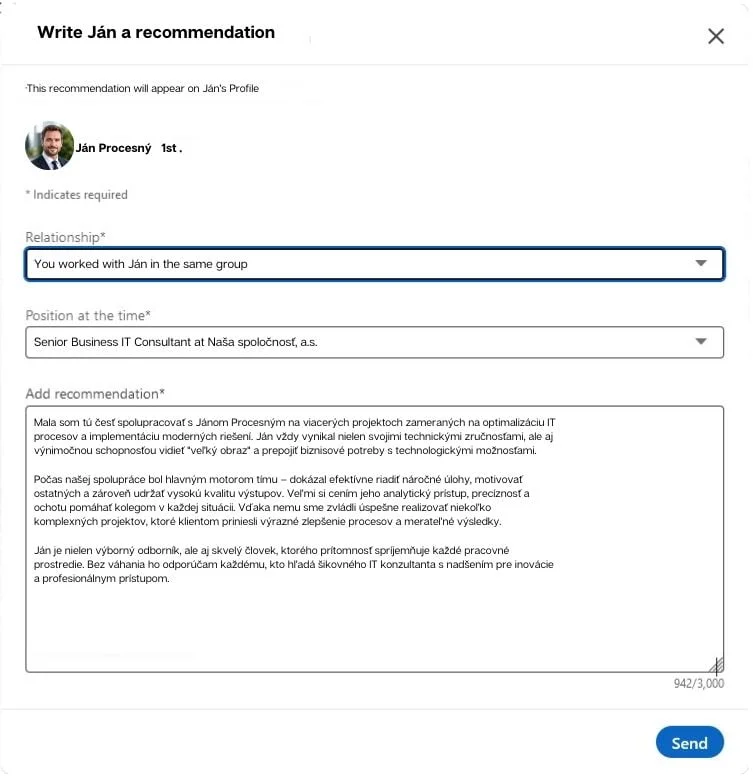
References on the social network LinkedIn are a separate reference category. You can get these digital recommendations from your contacts – superiors, subordinates or clients. They have several advantages:

References are important for several reasons. The main ones include:
You can provide references in a number of different ways, depending on what area you work in or who you’re applying to. Most often, they are included in the following documents:
You should include references in your CV in the following situations:
References are great and can help you, but they may not always be useful. For example:
Who you should ask for a recommendation depends primarily on whether you are a university student, a recent graduate or an experienced professional in the field.
You should never ask for references:
If you want to ask someone for a reference, you should do so professionally and respectfully. The best way to do this is to follow this procedure:
Employee reference evaluations do not have a precise template of what they should look like. However, they should include the following information:
To make it easier to write references, we have prepared a handy sample of employer references. Download the Modern CV Samples – References.pdf.
When a manager or colleague writes a reference for a former subordinate or colleague, they should follow a few basic rules to ensure that the reference is not only professional but also useful to the prospective employer. Here are a few recommendations:
“I worked with Jan Procesny during his five-year tenure in our company as a project manager. As his supervisor, I can attest to his high work commitment and professional approach in every area of his work.”
“Jan has exceptional technical skills, particularly in project management and working with software tools such as Jira and Asana. In addition, he has an advanced level in Microsoft Excel and has frequently used advanced features such as contingency tables and macros to analyze and visualize data. Jan is also fluent in English and has a working knowledge of German, which has enabled him to work effectively with international clients.”
“Jan is characterized by excellent organizational skills, which was especially evident when managing complex projects with a large scope. Thanks to his attention to detail, we were able to meet challenging deadlines while ensuring high quality results. He was also an active team member, always willing to help his colleagues. Jan is very reliable and always came with a positive attitude, even in stressful situations. He has exceptional communication skills that allow him to communicate effectively with different teams and solve problems quickly and independently.”
“Based on our cooperation, I am convinced that Jan Procesny will be an asset to any company looking for an experienced project manager with strong organizational skills and an eye for detail. I have no hesitation in recommending him.”
A reference structured in this way is clear, positive and offers practical information that will help a prospective employer in their decision-making process.
Which work testimonials and references are correct?
Proper job references on a resume meet these parameters:
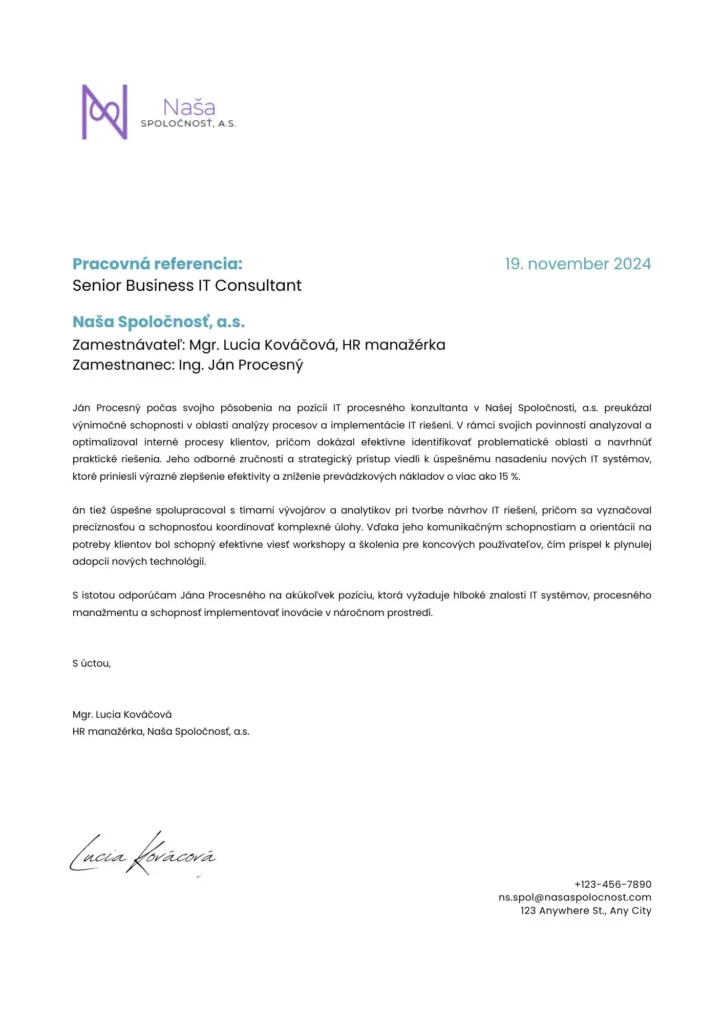
An employer reference template is a practical solution if you want to make writing a reference and finding a job easier. Remember, however, that an employer reference is not the only type of document that needs to be of good quality and well crafted. In addition to it, you will need a detailed CV and, if the employer requires it, a cover letter in which you can elaborate on your experience and skills.
At msg life Slovakia I take care of the company culture, events and I am part of the marketing team. I like a job where I can be creative and contribute to making my colleagues at msg feel good. I regularly prepare for you
not only news and interesting things from the world of information technology and insurance, but also from behind the scenes events at msg life Slovakia.
See who translates insurance into code at msg life Slovakia.